Tuesday, July 12, 2005

Class, Mobility and Opportunity


So, how do we, as a nation, build an economic system that stimulates growth while providing opportunity for as many of our citizens as possible to move up and out of poverty?

According to all the data, we are rapidly moving toward an economic system that, from a class standpoint, "freezes" folks in place, especially at the bottom.

The notion that anyone in America can pull themselves up by hard work, determination and persistence just doesn't hold up under the weight of the evidence now available. Even worse, it is now clear that class status is inherited and further solidified as it moves from one generation to the next.

Can nothing be done?

Are there no alternatives?

While it is obvious that not everyone in a capitalist economic system will be able to reach the upper echelon of wealth, it is simply untrue that public policy can have no affect on the status and prospects of the very poor and those positioned today toward the bottom of the economic pecking order.

The history of our nation reveals that public policy can impact economic status for large segments of the population. Consider, for example, recent chapters in American history.

Post-Depression economic and social policy lifted almost the entire nation out of economic despair and set millions on a path toward what would become middle-class America.

In the aftermath of World War II the GI Bill provided educational opportunity to a large segment of the population returning from national service.

For all of the criticism and revisionist history directed toward Lyndon Johnson's "War on Poverty," his public policy strategy, coupled with historic Civil Rights legislation passed during his watch, produced positive results for millions of very poor Americans of all races. The hard data from this period does not lie nor mislead.

The fact is we can do better as a nation and as people of faith.

It is no accident that American class mobility has been curtailed. Economic policy since 1980 has produced its intended results. Supply side economics, with its much heralded "trickle-down" effect that promised new jobs, new markets and new opportunities, has failed and failed miserably. The gap between rich and poor in our nation continues to widen.

What can be done to restore the legitimate and realistic prospect of economic mobility for those at the bottom?

Obviously, we must grow the economy. What does that mean for public policy makers as they consider what is needed at the bottom among low-income and very low-income Americans?

Here are just a few rather obvious steps we could begin taking today that would have great, long-term affect on our economy while establishing a more just system for everyone.

1. Don't just restore, but increase dramatically funding for PELL grants aimed at assisting low-income students to go on to college. Further, simplify the process for obtaining these important educational grants. Currently, the nation has turned back and away from students who seek support for higher education. This is not only morally wrong, it is stupid.

2. Increase the appropriation for the Earned Income Tax Credit program. This initiative rewards working people by providing a tax refund annually. Research reveals that most families and individuals use these funds to pay off debt, obtain transportation or take other actions that help stabilize their lives financially.

3. Extend healthcare coverage to more working people. Rather than cutting programs like Medicaid and the Children's Health Insurance Program (CHIP), we should be increasing funding for low-income workers. In the process we would be assisting small business owners who can no longer afford to provide health benefits to their employees.

4. Reverse recent cuts made by the U. S. Department of Housing and Urban Affairs (HUD) to the Section 8 housing choice voucher program. This creative and highly effective effort allows low-income working families to choose rental property anywhere vouchers are received as payment by landlords. Rather than cutting this program, we should be finding more funding to allow our working citizens to secure fit and affordable housing as they work for better futures. Currently, thousands of working Americans find themselves on long waiting lists to receive voucher assistance. Refusal to allow the voucher initiative to grow curtails affordable housing development and impacts the nation's economy.

5. Encourage skills training programs that result in workforce development for jobs that cannot be outsourced to foreign countries. The nation needs tradesmen and women. Carpenters, plumbers, electricians, transportation workers, environmental experts and foundation specialists will be needed in any growing national economy. Funding training programs that meet this need will be smart for the nation and for those at or near the bottom of our economy.

6. Do not make permanent the current tax cut strategy for those at the top. Do not eliminate the Estate Tax. Work to make our nation's tax code less regressive and more equitable, especially for low-income persons. Use the increase in funding to underwrite the initiatives discussed above, as well as others.

Establishing justice and fairness in the economy will involve political will and the courage to face tough choices, some of which will not be popular in all quarters.

Getting the nation--all of the nation--moving upward again calls for sacrifice, political will and a kind of practical faithfulness few leaders have considered.

[Photo by Hal Samples--www.herotozero--"Everything"]

Monday, July 11, 2005

Ole Anthony

Ole Anthony subsists on "earnings" of $55 per week.

What's remarkable about that is the fact that he chooses to do so.

Anthony heads the Trinity Foundation located here in Dallas, Texas.

Nationally, Anthony's foundation is best known for its work in monitoring and exposing unethical and illegal televangelists. You may have seen Anthony's expose that aired on Dateline recently concerning faith healer Benny Hinn. The foundation has a long history of exposing frauds in religious media.

Anthony will tell you that one of his motivations in going after these religious leaders has to do with how many of his own homeless friends report being ripped off by them as they decided to use their last few dollars to play religious lotto! You know, "Send me your money and God will reward you 100 fold!"

Anthony also publishes the satirical Wittenburg Door (see link to right here).

Anyone who knows Anthony or The Door immediately gets the logical connection!

Anthony has a reputation for being straight, challenging and tough on organized religion and the church in general.

But, back to the $55 per week.

Anthony and his friends live in a community arrangement here in East Dallas. The community includes successful professionals (Anthony made it financially big time in the 1970s) living literally side-by-side with formerly homeless persons.

Want a memorable and provocative experience? Drop in on the community for lunch any day. You will be welcomed and you will see a community at work.

Anthony had an idea several years ago about how to solve the problem of homelessness in Dallas. He calculated that the homeless population at the time was equivalent to the number of faith communities in the city. If each church, synagogue and mosque would simply "adopt" a homeless person, the problem could be addressed effectively.

By "adopt" Anthony did not mean give a handout and then be done with the persons who needed housing. Rather, he intended the development of relationships, caring to whatever depth necessary and the extension of respect along with the real expectation that the homeless had much to offer the non-homeless.

He also is clear that the commitment would be unconditional. "We know that some people take advantage of us and mess up," he shared in a recent speech. "But, we keep on anyway."

Having watched Anthony now for well over a decade, I can begin to connect the dots in his amazing life.

A very successful, but empty business man, Anthony encountered Jesus. Everything changed as he read after his new leader. He could easily see the emphasis of Jesus on people in need--"the least of these." He took the words of Jesus to heart.

He observed that lots of people and groups claiming to follow the same Jesus did not. Some even used their positions to rip off the weak and the vulnerable.

Now Anthony lives among the poor as a poor man himself. He challenges the forces of organized religion through his fascinating journal. He exposes the thieves among the faithful.

And, he continues to challenge the church in Dallas to get its act together about the poor and the homeless. We need to listen.

Sunday, July 10, 2005

Purpose

"If you want to identify me, ask me not where I live, or what I like to eat, or how I comb my hair, but ask me what I am living for, in detail, and ask me what I think is keeping me from living fully for the things I want to live for. Between those two answers you can determine the identity of any person."
- Thomas Merton, from The Man in the Sycamore Tree (taken from Heron Dance on-line newsletter)

Merton's words run deep, don't they?

Ironically, religion and the trappings of religious traditions can serve as barriers between who I am today and who it is that I truly desire to be.

For some of us, religion serves us well as a neat, manageable hedge, protecting us from the radical nature of life's call to our true selves. If I can safely occupy myself with covering all of the arbitrary bases of the traditions of religion and following precisely all of the agreed upon rules of "the faith," I may find it easier to avoid or simply miss many of the real issues life wants to open up before me or press upon me.

Jesus bumped into these same forces.

The system of religion he confronted with its various authorities and "enforcers" found his radical approach to life and, more importantly, to people unacceptable most of the time.

The folks caught up in that system of faith and thought found ingenious ways to neatly explain away human suffering and political injustice, while defending the status quo in pursuit of a rather narrow, self-serving, moralistic worldview.

Jesus called people to a different place.

He invited those who followed him to live for something far beyond selfish desire, materialism and the moralistic "cover" that provided personal, self-justification.

When it came to people, he encouraged inclusion rather than exclusion. When asked to interpret the law, he always explained that the rules in question were best understood as servants of people.

Ever wonder why Jesus identified so closely with the poor? Why did he spend so much time "hanging out" with them?

Many reasons, I am sure. But clearly he understood that the faith and values he wanted to communicate and clearly model would stand over against the values and the religious system that continued to "prop up" a social system of injustice, unfairness and oppression. His life was a one-person campaign for what Moses and the prophets referred to as a "Year of Jubilee."

Obviously, he was not popular with those he challenged and resisted.

But, he knew and lived his purpose. He resisted every force that stood between him and the completion of his mission, including the objections of the religious who remained blind to the fundamental connection between justice and the arrival of the kingdom of God.

Saturday, July 09, 2005

It's All About Class

You may have read the recent series in the New York Times focusing on the fact that Americans today have less class mobility than in the past.

Against the evidence, most of us actually believe just the opposite.

We still ascribe to the great American myth of the "self-made man."

This is important at a time when the gap between the rich and the poor widens every month. In spite of this growing chasm, an opinion poll conducted in 2000 reported that almost 40% of us believe that we are either members of the wealthiest 1% or that we are soon to be!

The fact that financial inequality is a fact of life today doesn't really get to me if I think I'm already at the top or will be able to get there soon.

As income disparity grows, social mobility tends to lock up.

Most of us underestimate the place of class in determining where a person ends up economically in life. We prefer to ignore factors such as social status at birth and the inherent privilege of some groups when compared to others.

We like to talk about genius, hard work as the determinants of success and economic status.

Turned around, we also buy into the notion that people who fail (i. e. the poor) do so because they lack intelligence or are lazy.

Very naive, to say nothing of self-serving.

Class at birth, something none of us had anything to do with, usually dictates where we end up in adulthood. Class status also is a reliable predictor for education, access to health care resources, housing, transportation, employment and power.

We need to set the "self-made man" myth aside, along with the idea that anybody can get to the top today.

Here's a fact to chew on: between 1980 and 2002, the bottom 90% of us experienced a decline in real income. On the other hand, those at the top watched their income double.

Amazing. Frightening.

We need not be surprised to see poverty grow and immobility solidify and deepen inequities in the U. S. No wonder we have so much work to do!

[These ideas flow from an interesting piece by David Moberg, "Class Consciousness Matters: What's Missing from the New York Times and Wall Street Journal" In These Times found at http://www.inthesetimes.com/site/main/article/2175/.]

Friday, July 08, 2005

Housing: Facing the Facts


I had lunch yesterday with around a dozen men and women who live on the streets of Dallas, when not bunking in a shelter. No way to do that and not think about housing.

People are homeless because we don't have enough housing.

Simple.

Tragic.

Immoral.

In 2001, ninety-five million people in the U. S. (one third of us) had housing problems (high cost burden, overcrowding, poor quality or homelessness).

Sixty-five million Americans with housing problems are low income as defined by the federal government (household income less than 80% of the area median).

Seventy-eight percent of extremely low-income people (household income at or less than 30% of the area median) have housing problems. This group totals 23 million people.

Here in Dallas County, an extremely low-income household (earning $19,530 or 30% of the median income) can afford monthly rent of no more than $488, while Fair Market Value for a two-bedroom unit is $868.

A minimum wage earner ($5.15 per hour) can afford monthly rent of no more than $268. In Dallas County a minimum wage worker would need to work 130 hours per week to afford a two-bedroom unit at Fair Market rent.

A person receiving Supplemental Security Income ($564 monthly) can afford monthly rent of no more than $169, though Fair Market rent for a one-bedroom unit is $713.

The so-called "housing wage" here in Dallas stands at $16.69 per hour. That is the amount a 40 hour-a-week wage earner must earn to afford a two-bedroom unit at the area's Fair Market Value.

As rents soar, people at the bottom are pushed out onto the streets. . . literally.

Homelessness is growing.

We don't have enough affordable units for working people who need them.

It is a fact.

Thursday, July 07, 2005

Knowing God

It can be a curious exercise to watch the ongoing battle over faith and values.

What does faith mean in the public square?

How are our public values to be informed and shaped?

Do values have to do with only matters of human sexuality? Or, should we broaden the conversation to include other crucial community matters?

Anyone who has been reading here for any time at all knows where I come down on these questions.

Yesterday I enjoyed a very unusual experience. I had been invited to meet with a group of teenagers from the Lake Highlands Church here in Dallas.

The group was on their annual summer mission trip. The unique thing about their "trip" this summer was that they stayed in town to explore as many mission possibilities right here in Dallas as they could find.

I was extremely impressed with this group of wonderful young people. I was amazed by their focus, their praise and worship time and their incredibly mature view of what life purpose involved.

After I spoke, several of the teens approached me to share their insights and, as they put it, "what the Lord had said to them" in the morning's events.

One young woman pointed me to an ancient Hebrew text found in Jeremiah 22:16.

Speaking of King Josiah of Judah, the prophet said,

"He judged the cause of the poor and needy; then it was well. Is not this to know me? says the Lord."

I find those words both gripping and telling for people in search of direction when it comes to civic values and faith.

The Judeo-Christian faith and value system addresses many matters.

The cause and the harsh reality of the poor are never left out by those who really understand.

Wednesday, July 06, 2005

Drugs, Prison and Neighborhood Decline


I've seen the cycle swirl again and again. It is sickening to watch.

A young man in Dallas, Texas, using drugs--in this part of town usually crack cocaine--is arrested for possession. No violence nor trafficking is involved during this first sequence. The court appoints an attorney and a plea is worked out that involves probation on the first offense and no prison time.

What the kid needs is treatment. Thanks to the fact that he is poor, what he gets is unemployment with the added challenge of finding a place to live.

Without treatment or a support group he falls behind on his probation fees and/or he is caught using again. Long story short, he ends up back in court. This time he faces prison time, usually in the range of 30 months or so depending on the amount of narcotics, if any, in his possession at the time of his arrest.

While in prison, he receives limited or no counseling services. Most productive opportunities come only at the end of his prison stay and aren't offered in enough concentration to do much good by the time he gets involved.

Once out of prison, he finds himself in an even deeper hole. Employment is now harder--actually, almost impossible to find. Housing presents a similar challenge.

What's a guy to do?

While I can think of several things he "ought" to do, the fact is he will likely try to do the right thing until it seems totally futile.

So, back he goes to the old corners of his life in the old neighborhood that got him started down this road in the first place.

The cycle repeats itself until he learns to sell dope, finds himself to be the father of a child or two or three, and decides that this is simply how his life is going to go.

He hardens. He resorts to violence. The journey turns bad, often tragic for him and everyone else.

The end result for his community is not pretty. Not only is he a crime statistic, he is no longer a potential leader or a positive force for change and renewal. The process appears to be a systematic "harvesting" of male leadership right under our noses in this community.

In Texas, as in far too many other states, drug use and addiction (even psychological as with crack) leads to prison, not treatment.

Prison doesn't work.

Prison is incredibly expensive.

But prison has become an industry with lobbying groups and power brokers to insure that it is fully funded going forward.

There has got to be a better, smarter, more humane way to address this unbelievable community problem.

And, of course, there is.

All across the nation states are waking up to the fact that sending non-violent drug users to prison is not only expensive, it is simply counter-productive.

As an example, for almost a decade now states like Arizona (not exactly Massachusetts from a social policy standpoint!) have decided to create court- mandated treatment programs to replace incarceration as the fundamental approach for dealing with these drug users.

The outcomes have been phenomenal. Recidivism has declined sharply. People leave the program to actually go to work on their way to assuming a positive role in their communities.

The last time I checked the stats for Arizona, the state was saving approximately $30,000 annually per inmate as compared to the cost of keeping a person locked up without treatment!

Recently, I read a report on a prison in Illinois that was converted entirely to a treatment center. Those involved received what they needed most--treatment rather than a criminal record.

It is way past time for this national movement of sanity, compassion and good sense to come to Texas, as well as to many other parts of the country.

Again, it seems to me that this involves important moral issues. People of faith should lead the way in seeing that this happens for the good of us all.

Tuesday, July 05, 2005

Reality Check: Poverty and Education


The connection between poverty and failure in our urban public schools needs to be placed in a community spotlight.

I was moved and challenged by two responses to a recent post on public education. What makes these words so important is that they come from teachers who understand the problem and observe, on a daily basis, the connection between poverty and poor performance in the classroom.

Here's what the teachers reported:

"My first year teaching public school I learned a difficult lesson about that very thing. One of my students was a 16-year-old girl who was raised by her mother. She had 3 sisters and 4 cousins, all younger. Her grades were average and she tried to sleep a lot in class. When I took the time to find out what was going on, I discovered that her mom worked two jobs while she took care of everything else. By the time she had made dinner, helped with bath time and got everyone else to bed, she was too tired to do her homework. I guess, what I saw in her case (which I suppose is true in many) is that students in poverty have many more things that weigh heavily on them that middle-class kids don't. When you're struggling just to stay fed and clothed, it puts your education lower on the list of priorities."
___________________________________

"Thank you for your comments on public education. I am a committed Christian educator teaching in a public school, and believe that my calling is to be right where I am - not separated and cloistered away from the world, but right in the middle of the circumstances that young people face each day. Sometimes I grow very discouraged - the political climate of education is stressing me out! We are charged with making all society's ills go away while parents frequently abdicate their role to educators. Other parents are unable to respond to the needs of their children because they are ill equipped to do so, being overly busy trying to make ends meet, to provide for their families. This past year, I had a young man who was more than just difficult... when I spoke to his mother, I found out that she was working 2 jobs just so they could have a place to live and food to eat - she did not have health care, and was desperate to know what she could do to support me and her son. My heart goes out to this dear woman. I made her son a special project, and we made progress. Nevertheless, this dear lady was in need - we must advocate for people such as this woman."
______________________________________

Many people who criticize public education simply don't understand what is going on inside our schools and in the neighborhoods surrounding them. Bad public policy affects our schools and the children who attend them. Possibly our apathy is the result of our lack of understanding about the connection between poverty and the challenges of public education today, especially in urban centers.

If we really want to understand, listening to our teachers may be a good place to start.

Any action taken to undermine poverty and its spread will also be a move toward improved public schools. There is a connection. We need more people exploring and understanding it.

Monday, July 04, 2005

We the people. . .


Yesterday in his pastoral prayer, Dr. John Fiedler, Senior Minister at First United Methodist Church here in Dallas, confessed that "freedom is not necessarily a great thing unless it is used to do great things."

The founders of our nation seemed to have understood this truth.

A little more than a decade after signing the Declaration of Independence, the founders went back to work on perfecting a plan for establishing the new nation on a solid constitutional foundation. It was not an accident nor an arbitrary choice of words that led the framers of this sacred national document to begin with the phrase "We the people."

The revolutionary struggle had been about independence and freedom. Freedom for individual colonists and freedom for the various groups and constituencies that populated the American colonies. After winning liberty and struggling with a government ordered by the inadequate Articles of Confederation, the new nation adopted a collective approach that launched the incredible American experiment in freedom and unity.

"We the people" is a phrase we need to remember on this the two hundred and twenty-ninth anniversary of the nation's independence. Freedom is not just about my individual liberty to do as I please.

I am free as a citizen of the United States, just as are all of my fellow citizens.

But, we are members of one American family that has been diverse and amazing from the beginning. We are all in this national experiment and journey together. The nation is an amazing collective of persons, interests, values, perspectives, traditions, assets and needs.

"We the people of the United States, in order to form a more perfect Union, establish Justice, insure domestic Tranquility, provide for the common defence [sic], promote the general Welfare, and secure the Blessings of Liberty to ourselves and our Posterity, do ordain and establish this Constitution for the United States of America."

In the "Preamble" to this original vision we discover exactly what is needed to renew our nation today.

Today millions of our fellow citizens and their children who live in the inner cities of our nation find themselves mired in a devastating, unforgiving poverty. Where is the hope for them on this day of national celebration? How do we find a way through the current situation to a better America for everyone?

I believe the answer is in the minister's prayer and in those first three familiar words of our Constitution, "We the people."

We enjoy freedom. Now what will we do with it as a people?

As a people we must find creative and sustainable ways to guarantee basic American rights to all of our people.

People who work hard in this nation should not have to want for a livable wage, decent housing, accessible health care, adequate and nutritional food, fair and equal treatment under the law or meaningful voice in the affairs of their various communities.

All of our children are entitled to a quality education in our public schools. Those who desire to go on to college should be able to do so with our assistance when it is needed. Those who opt for entering the labor market after high school should be prepared for work that will sustain them and their families. Our fellow citizens who need and desire training to properly fill positions of employment should be able to receive such training.

We the people should see to it that no one is limited, shut out or held back because of race, color, ethnicity, gender, religion, political philosophy, sexual preference or national origin.

The weakest among us--the children, the aged, the sick and the disabled--should be a constant national priority.

If we as a people decided to pursue such a path together, our cities would flourish again with health, hope and opportunity.

But, it's like the preacher prayed. Freedom is only great if it is used to do great things.

Sunday, July 03, 2005

Sunday Meditations

Hal Samples, my friend and talented photographer, produced this image. He calls it "Wasted Space." It hangs in my office as a reminder that the inner city contains much space that could be put to better, more productive use for people and families. I appreciate Hal for the constant reminder of my responsibility to partner with people who have been left out. Visit Hal's website at www.herotozero.org.

____________________________________________

"Human progress never rolls in on wheels of inevitability; it comes through the tireless efforts of men willing to be co-workers with God, and without this hard work, time itself becomes an ally of the forces of social stagnation. We must use time creatively, in the knowledge that time is always ripe to do right."


Dr. Martin Luther King, Jr., Letter from a Birmingham Jail
____________________________________________

World Bank Fact: In the United States, the poorest 10% of the population holds 1.9% of the nation's wealth, while the richest 10% controls 29.9%.
____________________________________________

"Anticipate charity by preventing poverty; assist the reduced fellowman, either by a considerable gift, or a sum of money, or by teaching him a trade, or by putting him in the way of business, so that he may earn an honest livelihood, and not be forced to the dreadful alternative of holding out his hand for charity. This is the highest step and the summit of charity's golden ladder."

Maimonides, b. 1135
_____________________________________________

"We must never claim that those who disagree with our judgments are not people of real faith."

Jim Wallis, editor Sojourners magazine
______________________________________________

Lectionary reflection for Sunday, July 3:

"A delighted, dancing response to a generous God ought not produce a faith that is so bent on controlling ourselves that we must crusade against others to subdue an unruly world. There is another way, says Jesus: 'Take my yoke. . .learn. . .for I am gentle' (Matthew 11:29). Dance on--it will change the world."

Robert Roth, Sojourners magazine, July 2005, page 48

Saturday, July 02, 2005

The New Faces of Homelessness and Getting Things Right


The recently completed
U. S. Conference of Mayors spent time deliberating about homelessness in the nation's cities.

Unfortunately, there's lots to discuss.

Many factors drive the harsh reality that is the growth of homelessness in our urban areas.

Here's a fact to chew on this holiday weekend: an individual or family working full-time and earning minimum wage, or receiving assistance under the Supplemental Security Income or Temporary Assistance for Needy Families programs cannot afford a one-bedroom or two-bedroom apartment at the fair market rental rate as established by the U. S. Department of Housing and Urban Development (HUD).

In other words, people can work full-time and still not be able to rent a decent place to live.

The mayors also reported that requests for shelter made by families with children went unmet 32 percent of the time during 2004. Families with children is the fastest growing segment among the homeless population of the United States. In Dallas, Texas, most all homeless families must break up at night if they choose to stay in one of our local shelters.

During the next 12 months, a minimum of 3.5 million persons will experience homeless. Forty percent (1.4 million) of these will be children.

One very practical step that could be taken to help relieve this tragic situation, especially for families with children, is for the President and Congress to restore full funding to the Section 8 Housing Choice Voucher program. Even better would be a public policy decision to expand the program to take in thousands of additional families.

The beauty of the Section 8 voucher initiative is that a family with a voucher can move anywhere in the city they call home where an apartment owner will accept vouchers as payment. The family pays up to 30% of their income and HUD pays the property owner the balance.

The outcome is win-win. Family members work. Private property owners keep their apartments filled. Family life is stabilized as fathers, mothers and children are kept off the streets.

At present, as a result of executive decisions made inside HUD, the Section 8 program cannot serve all of the families who need it. In Dallas the waiting list for a Section 8 voucher is well over a year. The list contains thousands of names. The story is the same in every major city in the nation.

Studies have demonstrated the clear benefit of the voucher program to the health and education of young children as compared to those who do not live in a household receiving this housing benefit.

If we truly care about the pressing needs of a growing population of homeless families, expanding the voucher program provides a clear plan of attack that will have immediate impact.

At the same time, such a move would bolster a very "soft" rental market in many American cities. Again, an economic and community win-win scenario.

So, what's the hold up? Why the problem?

I am convinced there is afoot in our nation today, a mean-spirited, harsh, anything-but-compassionate worldview that simply turns its back on the poor, even when the proposed solutions emphasize personal responsibility and accountability all around.

There is a very pragmatic, operational bias at work against the poor today in the United States.

People of faith who embrace the ancient values of our various religious traditions need to demand better of our nation and of its leaders.

This is a matter of national morality.

Friday, July 01, 2005

Kenneth

I've known Kenneth for almost 11 years.

He first came to Central Dallas Ministries just as we were realizing the importance of getting community people involved in every aspect of our work. Rather than keeping "poor people" in the "client" role only, we decided to give them the keys to the front door. We invited them to help us craft policy, deliver services and guide us into an unknown future.

Predictably, the reaction of people who had been associated with CDM previously was mixed. Some thought we had lost our senses. Others watched with curiosity. Most of our volunteers from outside the community (mainly from suburban areas) stopped coming. A few people were intrigued and stuck around to watch the show.

And, at times it was quite a show!

Kenneth and his wife arrived at the beginning of our organizational transformation.

Watching Kenneth respond to the new situation and the opportunities it opened up to him was fascinating to say the least.

Kenneth and his wife used crack cocaine.

We were inviting him to assume responsibility for his community in a big way.

At times the temptation afforded by his new found power and responsibility got the best of him. He stole food. He lied. He endured the discipline of our system which meant at times he was asked to stay away.

But, he always came back.

He helped operate our landscape service during a couple of long, hot summers. In spite of his "issues," I learned that I could basically count on Kenneth, even when he was struggling.

And, as time moved along, he changed.

I realize his personal growth was the result of many factors.

He almost died in a fire--in house fire that took the life of his wife.

He began to work again on a steady basis. He orbited around the life of the church. He would come and go.

He moved into another part of the city and I lost track of him, except for his occasional drop-in visits that occurred maybe once or twice a year. It remained very important to him to check in with us to report on his progress or his setbacks.

Kenneth came by to see me earlier this week.

He was recruiting employees for his newly opened auto repair shop and for his remodeling, contracting business.

"I need to hire 4 or 5 guys, Larry," he beamed.

"I knew there would be folks here for me to talk to," he continued.

We enjoyed a brief visit and he was off to work.

He will be interviewing several men that we are sending his way.

Working with and for Kenneth will be a good experience for the guys he hires.

I've often wondered what was most important to Kenneth in his personal renaissance.

I think I know.

The community challenged him to step up. And, he did. Haltingly at first, but he stepped up.

He knew we loved him.

He had respect and a clear knowledge that people believed in him. That is all about the stuff of purpose and hope.

He also found resources, many of them material, at his disposal. He had access to the opportunities built into our system of concern and fairness. He found a place open to giving him a chance.

He found what this nation needs to offer everyone willing to step up and take advantage of opportunity. Sadly, not everyone finds what Kenneth found. This harsh reality needs to change, and quickly.

Kenneth is one special friend. A poor man making his home in the middle of the city. Doing well, thanks to his own determination and to the proper alignment of a few essentials for success.

Thursday, June 30, 2005

Live 8: The Long Walk to Justice


This Saturday, July 2, 2005, Live 8: The Long Walk to Justice, a massive, worldwide event, will blast out music from the world's top performers. The purpose of Live 8 is to draw attention to the problems associated with poverty in Africa in advance of the G8 Summit in Scotland from July 6-8.

British Prime Minister Tony Blair is expected to make a push for more aid dollars for Africa at the economic summit.

Concerts will draw masses in Berlin, Johannesburg, London, Paris, Philadelphia, Rome, Tokyo and near Toronto, with Moscow being a ninth possibility.

Irish rock star Bob Geldof agreed to coordinate the gigantic event. According to an AOL report, "Geldof pulled off a show business sensation 20 years ago, when the Live Aid concerts in London and Philadelphia raised more than $100 million to help fight famine in Ethiopia and an estimated 1.5 billion viewers tuned into watch."

What I found interesting and most encouraging was the fact that Geldof would not agree to be involved in the proposed event until he was convinced that it would have substantive affect on the targeted problems.

Richard Curtis, a film writer and producer who has worked with Geldof on similar events in the past, noted about Geldof, "He always said he wouldn't do it until he believed there was a moment when it could make political change and not just charity. . . .

"There are only weeks to go until these men meet and. . .that's the last G8 for another year. The next one is in Russia where poverty may not be the key issue."

Curtis reported that Live 8 organizers were looking for the fair trade issue to appear on the G8 communique and for a doubling of aid from rich nations.

"What we're trying to do is provide a moment in history."

That is definitely what is needed--a moment in history.

The spirit of Geldof and Curtis reminded me of the words of Rev. William Sloane Coffin from a sermon delivered in Washington, DC in 2002:

"Had I but one wish today for the Christian churches of America, I think it would be that they come to see the difference between charity and justice.

"Charity is a matter of personal attributes, justice a matter of public policy. Charity seeks to alleviate the effects of injustice, justice seeks to eliminate the causes of it.

"Charity in no way affects the status quo, while justice leads inevitably to political confrontation.

"Especially I would hope that Christians would see that the compassion that moved the Good Samaritan to act charitably--that same compassion prompted Biblical prophets to confront injustice, to speak truth to power, as did Jesus, who, though more than a prophet, was certainly nothing less.

"Most recently, religious leaders like Desmond Tutu and Martin Luther King have seen once again that compassion frequently demands confrontation."


Geldof and Coffin are on point.

Enjoy the music if you have the chance on Saturday.

Visit the Live 8 website at http://live8.technorati.com/about/live8.html to learn what you can do to be involved.

While you are at, it follow the links to The One Campaign here in the U. S.

Sign the online letter to President Bush asking for his support at the upcoming G8 meeting for an unprecedented debt-aid-trade deal for the people in the poorest countries of our world--mainly in Africa.

Even more important, begin to seriously consider the place of justice in your faith and values system. And, when given the opportunity, insist that others do the same.

Wednesday, June 29, 2005

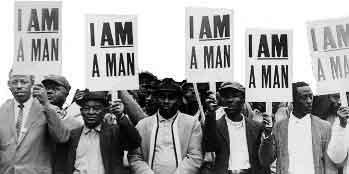
I Am A Man!


Recently, while preparing a presentation to share with participants in a summer work camp focused on housing repair in inner city Memphis, Tennessee, my friend and partner, Charles Senteio (check out the link to his blog at right) sent me a copy of Robert Worsham's moving poem, "I Am A Man."

You may recall that Dr. Martin Luther King, Jr. used this poem during his last public action among striking sanitation workers in Memphis. Dr. King's fateful trip to Memphis in April 1968 ended his life, but not his dream.

As I read over the poem again, I can feel the power and the spirit of a movement for justice in our shrinking world's troubled economy.

Don't look at me with disdain,
For I am not a weakling, I am a man.
I stood when to stand
Brought severe reprimand,
I spoke, when to speak
Brought denunciation from the weak,
And brutal attacks from those in power,
But to me this was my greatest hour,
With chin thrust out and head up proud,
I stood up straight and I said out loud,
I am a man!
And I shall always defy
The oppression of mankind
until the day I die.


The photo above was taken during the sanitation workers' strike.

Dr. King stood with his brothers to affirm them in their claim of this more than obvious human reality. Dr. King's involvement also made clear his commitment to work for economic justice in addition to racial equality. For Dr. King both were central to his faith.

When it comes to employment and the day-to-day and year-to-year issues facing laboring people, it seems that the church today has little or nothing to say.

If anything, there appears to be a growing movement among AmericanChristianss in support of public policies which actually widen the economic gap between rich and poor in the nation. Executive pay continues to rise while laboring people slide farther and farther behind. Federal tax policy disproportionately benefits the wealthy at the expense of low-income working people.

Shame on us as people of faith and on our leaders and spokespersons.

Working people deserve fair wages. Working families should be rewarded for their labor.

Included in the rewards that hard working people have a right to expect should be adequate, affordable housing; good health care options; high-quality educational opportunities for themselves and their children and, most of all, respect and voice.

Most of the people we engage here at Central Dallas Ministries work and work hard.Their work just doesn't pay off like it should.

My faith tells me that fairness and justice in matters of labor, production and profit are value issues plain and simple.

I believe Dr. King would have agreed.

That's why he went to Memphis.

Tuesday, June 28, 2005

Public Education and Poverty

Interested in seeing public schools improve?

Then join the battle today against poverty and its deepening impact on the nation.

Chris and Sarah Lubienski, University of Illinois professors, report in a new study that the money spent to send children to private schools does not insure that students receive a better education than students who study in public classrooms.

The Lubienskis analyzed the math scores of tens of thousands of students who took part in the National Assessment of Educational Progress. When these scores are reported each year, students from private schools always produce higher scores overall than students in public schools.

But the Lubienskis wondered why.

Were the private school scores higher because the instruction was better, thus justifying the tuition payments? Or were the scores higher for some other reason?

In their research the couple created a grid to control for class and economic status of students and their families. They dug deeper into the family life of the students who took the test. The asked a series of questions to help in determining just who these students were.

How many qualified for free school lunches? How many lived in a household with access to a computer? How many had parents who dropped out of high school or completed college?

With controls in place for socio-economic status, the project compared public and private test scores.

The result?

Public schools out performed private schools nationally. Further, the public school students reported scores higher than private school students at all class or economic levels.

One conclusion seems obvious, as Joshua Benton of The Dallas Morning News puts it, "The reason private schools look better on paper is because they serve more middle- and upper-class kids" ("Can cash buy good schools?" Monday, June 27, pages 1 & 6B).

The bottom line is clear here. The most important indicator for educational success in this country is socio-economic status.

The Lubienski's findings square with the facts. Private schools typically don't have all of the institutional resources of public schools. They do have one thing public schools generally don't have: a more affluent student body.

So, the next time you hear someone touting the superiority of private education from an educational standpoint or when you hear someone comparing the public school district of a more affluent suburban area to a poor urban area, remember what is underneath such comparisons.

Want to see public education improve?

Get involved in the battle against poverty.

Remember as you begin that adult illiteracy, inadequate housing, underemployment/poor wages, inaccessible health care, drug addiction and a lack of community economic development are all extremely important issues for the improvement of public education.

Monday, June 27, 2005

PurpleOcean.org--check it out!

Working people, I mean people who go to work every day and earn an hourly wage, aren't doing too well in America today.

Our major focus here in inner city Dallas connects us with hard working people who don't earn enough to make life work for themselves and their families.

Unfortunately, their number is growing and, if our numbers are any indication, growing rapidly. Over the past four plus years we have seen the need grow in a sadly amazing manner.

When a friend sent me information about PurpleOcean.org, I discovered interesting ideas and actions!

PurpleOcean.org is aligned with the Service Employees International Union, a collective of 1.8 million families who form a large chunk of the service sector in this country. Nurses, custodians, librarians, child care workers, restaurant employees and many other laborers make up the growing membership.

As you might expect, PurpleOcean.org works hard on issues relating to economic justice, labor and fair wages. Important issues among my friends here in Dallas.

Check it out. You will be challenged, even if you don't agree with everything!

Labor and justice--issues of the spirit, matters of faith to me. Let me know what you think.
_____________________________________

Meditation from the New Testament--the words of the brother of Jesus: James 5:1-6

Sunday, June 26, 2005

Celebrating An Opportunity In Inner City Dallas

This is not a venue for commercials, but I cannot resist sharing the good news with people who care!

Recently, Central Dallas Ministries reached an agreement with the Dallas Housing Authority that contracts us to manage the new community center located in the midst of the Roseland Homes Public Housing Development here in inner city East Dallas.

For years we have dreamed of building just such a center to better engage and partner with the surrounding community.

Now one of our best public partners has built the center and invited us to manage it and the programming that will be offered to the neighborhood.

What an amazing development and opportunity!

We have been working at Roseland Homes since 1996 when we opened our second summer-long day camp for the children who live there.

Since 1996, the CDM presence has steadily grown inside the Roseland Homes community.

We operate an emergency service center for families in crisis on site.

We operated a medical clinic from 1996 until the HOPE VI rehabilitation project moved us out. We plan to re-open the clinic in a new space next year.

Our Cyber Spot technology center is a Neighborhood Network project funded in part by HUD dollars.

Recently, CDM purchased the Washington Street Mission just across the street from Roseland Homes. The Central Dallas Church meets there.

Before the end of the summer our community development corporation will break ground on a 237-unit housing development that will include approximately 45,000 square feet of retail space--a real housing and economic development effort that has CDM in a partnership with the Dallas Housing Authority.

Currently, we have a team working on a community organizing project whose aim is to develop social capital and neighborhood connections as a means of improving community health outcomes while attacking the disparities that we know all too well.

But, back to the community life center.

Take a moment and look at our website to see the details of this opportunity:

http://www.centraldallasministries.org/dev/roseland/index.htm

We are excited!

Saturday, June 25, 2005

More on churches and "helping the poor"

Years ago my friend, Landon Saunders, told the story of how he and a church leader made a visit to a family in the community where he served as minister.

For whatever reason this particular family had asked the church to help them in a time of financial need.

I can't remember if they needed help with rent, utilities, food or what. I do remember Landon's account of the church leader's agonizing over whether or not the family in question was "worthy" or deserving of the church's assistance.

During the ride out to make the visit, the leader continued to struggle and at times argue with Landon about using church funds to help relieve the family's burden.

Finally, after much talk and no little tension, Landon told his church friend, "You know, brother, if the good Lord feeds and cares for four billion undeserving people every day, it looks like the church could help out every once in a while!"

With that the conversation ended and the family was assisted.

Making judgments about other people is tricky business, isn't it?

The sad fact is that millions of people, including children, go to bed hungry, homeless, ill and in danger every night around our world. Categories like "deserving" or "undeserving" make no sense in situations of severe human need and suffering. This is all the more true when suffering and need are the result of injustice, oppression and the bad decisions of people with power.

Friday, June 24, 2005

"Give to everyone who begs from you. . .," but only after a reference check!

Let me apologize upfront for my attitude and hard to suppress anger on this one.

Recently, I received a high quality mailing from a national, church-based organization offering me their unique services. The really slick, multi-colored brochure promised a lot.

"Taking The Guess Work Out Of Your Benevolent Program. . ." the tag line read.

"How Do You Know That The Individual Seeking Assistance Really Needs It?" the inside heading asked me.

The promotional/sales piece provided the answer:

"That's the question that faces every church as they administer a benevolent program. Times truly have changed from when you could trust everyone that asked for help. Sad but true, it is common place for individuals to use the church. Many times they will travel from church to church receiving multiple help for a single need.

"How can you know where they have been and how much they have already received? Is it a real need, or are they simply living off benevolent organizations. Well, now there is a way that you can be sure."


The information goes on to unveil the web-based screening product that allows a church "benevolent program" 24/7 access to the records of other member organizations. The goal is to eliminate funding "professional beggars," while becoming "a better steward of God's money."

I hardly know how to respond.

This new "technology" tells me that the people behind many church "benevolent programs" don't understand much about poverty or what it means to really engage the so-called poor in a manner that builds relationships and community.

The fear-based control system presented here assumes that the funds being distributed belong to those who have control of them. Talk about building walls between the haves and have nots.

The paradigm underneath the solution to the perceived problem is all wrong.

"Benevolent programs" as a concept cannot move churches beyond paternalism.

Christian compassion should propel us to a much different place. Never mind all that could be noted here about working for a more just economy and society--an endeavor churches could and should pursue with significant success it seems to me. Where is the church leader who will ask why it is that people would resort to such measures to make it through life?

The obvious irony of this entire matter has to do with the scope and scale of church-based benevolent programs in general. Most churches do well to manage a "food closet." In fairness, many do much more than this. But how many churches go beyond programatic thinking when it comes to the poor?

Worrying about being "ripped off" by the poor runs counter to the open-hearted radicalism of Jesus--a challening worldview we need to explore deeply.

Possibly our overblown concerns about being taken advantage of says more about us than it does about "the poor."
____________________________________________________

"Give to everyone who begs from you, and do not refuse anyone who wants to borrow from you."

Jesus (Matthew 5:42)

Thursday, June 23, 2005

Poverty, Health and Choice

Poverty is a cruel, but effective teacher.

Materially poor people do not enjoy the same health status as the materially rich.

No surprise there, huh?

But, why?

No doubt a diet limited and defined by available cash plays a role. Convenient and ready access to health care providers or, better, the lack of such access is another factor back of this documented deficiency.

Safe neighborhoods lending themselves to outdoor activities, exercise and routines of physical fitness also play a part in the health outcome disparities that characterize low-income communities when compared to more affluent areas. Accessible parks and health clubs do make a difference.

An even larger factor is often not recognized by most people, including some public health officials and political leaders. Choice, self-determination, options--these are the key determinants of health.

Typically, these factors are all related to income.

But, we are learning.

People with few material resources can find hope in simply getting together.

Collective efficacy matters. Political power and the choice it delivers is a key factor in improving community health.

Poor people who band together, who pool even limited resources and cooperate to achieve community goals, also enjoy improved health outcomes. Connections to and membership in neighborhood groups such as crime watch organizations, PTAs, churches and civic groups contribute to improved health status. These are the sorts of connections that the materially rich take for granted and seldom, if ever, relate to their own health.

At Central Dallas Ministries we operate a large community health ministry complete with doctors, medical assistants, pharmacy, dentists and testing services. However, we are learning that community connections and organizing is likely to be even more important for the long term health of the community than our clinical efforts.

While we will continue to provide highly accessible, community-based clinical services to our low-income neighbors, we know that we must also engage our friends at a deeper, relational level.

Building community among and with "the poor" is the legitimate work of people committed to seeing health status improve in the inner city.

At times this work will offend some who observe us. We will do our best to explain with patience and kindness, but we will not stop.

Improving the health of low-income Americans must involve political mobilization.

For us this work exemplifies not only our most cherished values, but our brand of spirituality.

Meditation for today: Isaiah 65:19-25

Wednesday, June 22, 2005

Pastors in the Streets

When I was growing up, preachers had a tendency to hit the streets.

Images of white ministers, most of them "collared," and black ministers, most of them Baptist, marching in the streets of most major, and some not so major, American cities remain etched in my memory.

The life and work of Dr. Martin Luther King, Jr. included lots of this "street work." His message mobilized the nation and led to significant changes in civil rights legislation, as well as national attitudes concerning race, poverty, fairness and equal opportunity.

His impact also "turned out" the pastors who marched at his side.

Many of the images were extremely impressive. They still affect me.

King's message remained thoroughly biblical from start to finish. Thus, his success with the pastors and thousands from their congregations.

These preachers engaged in fairly radical behaviors.

They organized mass demonstrations, participated in economic boycotts, supported and took part in sit-ins and protested based on their clearly defined, values-based agenda.

These ministers made it very clear as to where they stood on these matters.

Racism was an evil that needed to be challenged and eradicated from American culture, economics and law.

Poverty was an enemy against which the nation's resources could and should be marshaled with determination and moral courage.

War with no moral basis could not be accepted. At the very least, honest, open debate had to be defended and championed as a legitimate and accepted fact of life in our democratic system.

The preachers I watched on television as a young boy were not trying to build their churches. There were no megachurches back then. No, these ministers were attempting to lead their congregations and the nation in the ways of God out in the public square.

The actual results of their actions on American life and policy remain impressive.

These days I find myself longing for those days.

From my point of view it is not for the absence of moral issues that the streets are empty of preachers today.

Our economy and the public policy that sustains it continues to crush the poor while promoting the rich.

We are enmeshed in an unbelievable war with no end in sight.

Here in Texas our legislature left Austin for the second session in a row without passing a school finance plan. They did manage to get a marriage amendment approved for voter consideration in the fall--like Texas needs that! But, they left our children and our teachers hanging. Now our governor has called for a special session. I wonder if the poor children of Texas will fare better at the end of this next round of debate than they did during the first?

Yet, the preachers remain locked away in their churches. The streets remain empty.

It appears to me that the vacuum relates to courage, depth and direction of message and the widening gap between current theology and daily reality, especially for the poor in our nation.

The silence haunting our empty streets may also relate to the growing chasm dividing the poor and the rich in our nation. Speaking out, organizing and taking action may be too costly to consider these days. I don't know.

A few years ago while attending a seminar in Atlanta as part of the Interfaith Health Program at Emory University, I met a Cambodian monk who was the national leader of his part of Buddhism. During the bloodiest part of his nation's recent history that produced the "killing fields of the Khmer Rouge, he risked his own life to walk across Cambodian protesting violence and promoting peace.

His words about the life of monks challenged me when I first read them:

"We Buddhists must find the courage to leave our temples and enter the temples of human experience, temples that are filled with suffering. If we listen to the Buddha, Christ, or Gandhi, we can do nothing else. The refugee camps, the prisons, the ghettos, and the battlefields will then become our temples. We have so much work to do.

"This will be a slow transformation, for many people throughout Asia have been trained to rely on the traditional monkhood. Many Cambodians tell me, 'Venerable, monks belong in the temple.' It is difficult for them to adjust to this new role, but we monks must answer the increasingly loud cries of suffering. We only need to remember that our temple is with us always. We are our temple."
(Step by Step: Meditations on Wisdom and Compassion, Maha Ghosananda).

My Cambodian friend speaks the truth here.

Life for the poor will not improve until people, and especially leaders, of faith begin to publicly engage and challenge injustice once again.

Monday, June 20, 2005

Institute for Faith Health Research--Dallas

Late in 2003, Central Dallas Ministries formed a subsidiary organization, the Institute for Faith Health Research--Dallas.

The goal was to provide a platform for serious research around the issues of health and faith/spirituality. Our own research was telling us that community health outcomes can be affected by the dynamics of faith individually and collectively.

We also were learning the social capital provides increased power, choice and autonomy to communities. We were eager to see the impact of the creation of social capital measured so that empirical evidence would be accumulated for use in our basic work of community development.

The mission of the Institute is clear to us: Working with Community and Faith Based Organizations (FBOs), the Institute exists to study and develop replicable models of community health improvement; alleviate and prevent unnecessary suffering; and promote community wellness both nationally and internationally.

We divide the focal work of the Institute into three areas or "pillars."

Community Education: To teach theoretical and practical fundamentals in faith-health collaboration to community leaders and students.

Community Research: To study and disseminate information on faith-health collaborations and their contribution to community health improvement.

Community Advocacy: To promote public policy development that encourages individuals, institutions and communities desiring to enter into collaborative relationships to impact community health.

This part of our work has been flying under the radar to this point. But we have attracted the attention and the commitment of several academic partners and we have significant research projects underway.

Please take the time to visit our website at http://ifhrd.org.

While you are there notice our partners and current research projects (http://www.ifhrd.org/currentresearch.aspx).

Sunday, June 19, 2005

Daddy and the trash men

My parents both grew up dirt poor, the children of West Texas share croppers. My father was a cotton farmer before WWII. He and his family wrested a living out of the dry, red dirt north of Abilene, Texas in Stonewall and Haskell Counties.

After the war my parents moved away from Texas following what they hoped would be a quest for a better life, first in Des Moines, Iowa and then in Spokane, Washington, where I was born. My arrival drove them back home to Texas nearer to family. They settled in Dallas this time, moving out to a sleepy little village at the time, Richardson.

When I was growing up, Richardson was Mayberry. You could ride your bike from one end of town to the other--hitting countryside on both ends! Everyone in town knew you, so there wasn't getting away with much back then!

My dad went to work for the City of Richardson as the City Secretary. His job was demanding and grew more so as the town begin to grow rapidly. As the 1960s got underway, my dad joined a development firm and worked building out the west side of town. He worked hard.

I learned a lot from my dad. But the most important thing I learned from him had to do with how to regard other people, no matter who they were or what they did.

When I was just a little boy, I remember vividly driving through downtown Dallas late one evening on our way home from a visit to my grandparents who lived in Oak Cliff. My grandfather was a night watchman in one of the large office buildings under construction at the time. On this particular evening the rain was pouring down.

Just after dropping Gramps off at his job and as we were making our way up Main Street, a man who was drunk stumbled out into the street and fell down in front of our car. I can remember my dad getting out in the rain to help the fellow. I never forgot that scene for some reason.

I grew up watching my father meet the trash men who collected our garbage at home with cold soft drinks or cold water. To this day the garbage crews who take care of his trash know to expect him waiting for them with something cold to drink. They all know him.

My dad has treated everyone that way all of his life, so far as I can tell.

He never judged others based on status or money or job description. The people who worked for him always loved him because they knew he would be fair, understanding and kind. They knew he was honest and unmixed.

My father joined the church in Richardson when I was about 11-years-old. He has been quietly involved in the same church for the past forty-four years. As a kid, I noticed that my dad didn't like to pray in public. When asked, except on a rare occasion or two that I recall, he always declined that assignment. I think he didn't feel as if he could do as good a job as some others. Or, possibly he felt somehow "unworthy" by church standards to fill this role.

I think he felt bad about it. I remember feeling bad for him, but never about him.

More than once he was asked to consider serving as an elder or deacon in the church. He always declined.

While I don't know all the reasons, I respected him then and I understand even more now.

He is 85-years-old today. My dad's faith remains very strong and simple. His creed runs something like this.

Believe deeply. Love widely. Take care of your own business as you know you should. Care for your family. Treat others just as you would enjoy being treated. And remember, we are all the same and God loves us all.

Not long ago I was at my parents' home. When he heard the trash truck, he excused himself to go and greet his good friends, grabbing a couple of soft drinks on the way out the door.

Saturday, June 18, 2005

Heron Dance

Working and living in the middle of the city creates a longing for deeper connections to nature and mystery and life, simple life. Several years ago I discovered a great publication and website, Heron Dance. The little journal combines poetry, prose, and painting in an extremely satisfying manner. I urge you to check it out at www.herondance.org.

Being Still

She's a quiet clapper in the bell of the prairie,
a girl who likes to be alone.
Today, she's hiked four miles
down ravines' low cool blueness.
Bending under a barbed wire, she's in grass fields.
She's at the edge of the great plains.
Wise to openness, she finds it a similar place.
Her clothes swell like wheat bread.

When she returns to her parents' house,
the foxtails and burrs have come home, too.
The plants seem intent on living in new ground.
She's the carrier. Carrier is a precision
learned in summer's biology class.
She likes to think of ripening seeds,
a cargo inside the bellies of flying birds.
Birds like red-winged blackbirds who skim the air
and land, alert on their cattail stalks.

They allow her a silent manner.
They go about their red-winged businessof
crying to each other, dipping their beaks
into the swampy stand of ditch water,
full of the phantom of green.
The stiller she is, the more everything moves
in the immense vocabulary of being.

- Margaret Hasse, from the book Stars Above, Stars Below published by New Rivers Press (From Issue 24 of the Heron Dance journal)

Friday, June 17, 2005

Stone Soup

Three soldiers trudged down a road in a strange country. they were on their way home from the wars. Besides being tired, they were hungry. In fact, they had eaten nothing for two days.

"How I would like a good dinner tonight," said the first. "And a bed to sleep in," added the second. "But that is impossible," said the third.

On they marched, until suddenly, ahead of them, they saw the lights of a village. "Maybe we'll find a bite to eat and a bed to sleep in," they thought.

Now the peasants of the place feared strangers. When they heard that three soldiers were coming down the road, they talked among themselves. "Here come three soldiers," they said. "Soldiers are always hungry. But we have so little for ourselves." And they hurried to hide their food. They hid the barley in hay lofts, carrots under quilts, and buckets of milk down the wells. They hid all they had to eat. Then they waited.

The soldiers stopped at the first house. "Good evening to you," they said. "Could you spare a bit of food for three hungry soldiers?"

"We have no food for ourselves," the residents lied. "It has been a poor harvest."

The soldiers went to the next house. "Could you spare a bit of food?" they asked. "And do you have a corner where we could sleep for the night?"

"Oh, no," the man said. "We gave all we could spare to the soldiers who came before you."

"And our beds are full," lied the woman.

At each house, the response was the same -- no one had food or a place for the soldiers to stay. The peasants had very good reasons, like feeding the sick and children. The villagers stood in the street and sighed. They looked as hungry as they could.

The soldiers talked together. The first soldier called out, "Good people! We are three hungry soldiers in a strange land. We have asked you for food and you have no food. Well, we will have to make stone soup." The peasants stared.

The soldiers asked for a big iron pot, water to fill it, and a fire to heat it. "And now, if you please, three round smooth stones." The soldiers dropped the stones into the pot.

"Any soup needs salt and pepper," the first soldker said, so children ran to fetch salt and pepper.

"Stones make good soup, but carrots would make it so much better," the second soldier added.

One woman said, "Why, I think I have a carrot or two!" She ran to get the carrots.

"A good stone soup should have some cabbage, but no use asking for what we don't have!" said the third soldier.

Another woman said, "I think I can probably find some cabbage," and off she scurried.

"If only we had a bit of beef and some potatoes, this soup would be fit for a rich man's table." The peasants thought it over, then ran to fetch what they had hidden in their cellars.

A rich man's soup, and all from a few stones! It seemed like magic!

The soldiers said, "If only we had a bit of barley and some milk, this soup would be fit for a king!" And so the peasants managed to retrieve some barley and milk.

"The soup is ready," said the cooks, "and all will taste it, but first we need to set the tables." Tables and torches were set up in the square, and all sat down to eat.

Some of the peasants said, "Such a great soup would be better with bread and cider," so they brought forth the last two items and the banquet was enjoyed by all.

Never had there been such a feast. Never had the peasants tasted such delicious soup, and all made from stones! They ate and drank and danced well into the night.

The soldiers asked again if there was a loft where they might sleep for the night.

"Oh, no!" said the townfolk. "You wise men must have the best beds in the village!" So one soldier spent the night in the priest's house, one in the baker's house, and one in the mayor's house.

In the morning, the villagers gathered to say goodbye. "Many thanks to you," the people said, "for we shall never go hungry now that you have taught us how to make soup from stones!"

[Shared with me by John Greenan, found partner of Central Dallas Ministries' LAW Center, General Counsel for CDM and Executive Director of Central Dallas Community Development Corporation. Found on a great website: www.storybin.com.]

Thursday, June 16, 2005

Working and Hungry in America

The following comes from Sojourners Magazine (June 2005), "Am Working and Hungry," by Claire McKeever.

Low-income persons and families across the United States will increasingly need more services to enable them to meet acceptable standards of living, according to a 2004 report on hunger and homelessness by U.S. mayors.

"The president and other political leaders should be focused on rewarding work with living wages, not accepting that 34 percent of adults needing food are employed," Yonce Shelton, director of public policy for Call to Renewal in Washington, D.C., told Sojourners.

In Cleveland, more than 30 percent of the population lives below the poverty level, and these numbers are predicted to get worse in the next year.

"While government is not the only solution to poverty," says Shelton, "right now ours is not just ignoring poor families, it is knowingly hurting them."

56% of people requesting food assistance in the U.S. during the past year were children.

70% of the 27 cities surveyed report an increase in requests for emergency shelter.
An applicant for public housing waits an average of 20 months for assistance.
Low-income households spend up to 45% of their income on housing.

48 education programs have been cut in the Bush administration’s budget, and support for food stamps has been reduced.

Source: "The U.S. Conference of Mayors: Hunger and Homelessness Survey 2004."

Wednesday, June 15, 2005

Children Are More Than Their Tests

Marian Wright Edelman's Child Watch ColumnJune 4, 2005

CHILDREN ARE MORE THAN THEIR TESTS

I talked recently with a Black grandmother with a second grade grandson who asked me to pray for him. He was in the middle of testing for the week in his exclusive private school and was stressed out. A smart child, she feared he might not be the quickest responder on the tests and thought the week long process was a lot of pressure for such a young child. He and she felt extra pressure because he was the only Black child in the room and she did not want him to feel or appear to be dumb if he didn't do as well as his privileged White peers.

So many children are weighed down by the expectations and needs of adults - good and bad. Parents, teachers and administrators need to have high expectations for all children, but they also need to be mindful of trying to judge children's intelligence and talents just on the basis of tests or fit our children into a single label, simple box, and the convenience of school systems. Schools exist to teach and help children learn and develop the whole self: mind, body and spirit. Appropriate tests should identify children's strengths and weaknesses in order to better help not stigmatize them.

I strongly support holding schools accountable for educating every child and support the disaggregation of children's academic progress by race and income. But the do or die testing underway under the No Child Left Behind Act is causing many children great harm.

Too many schools are teaching to the tests rather than teaching to the child. Too many educators are over labeling children as special needs children to exempt them from regular testing procedures so their school will look better. Too many children are being retained in a grade without getting the extra help they need which increases the risk of them dropping out of school and puts them at greater risk of being sucked into the prison pipeline. And too many schools are transmitting their fears of being labeled a failing school if children don't do well on the tests by pushing them out of school for behaviors that are often a cry for help.

We need to remember that each child is an individual. Policymakers, parents and teachers need to see and respect the various ways and paces children learn and develop even as we try to make sure that they gain all the basic competencies they need to succeed in life. Reading , computing, writing and thinking are crucial, but creativity and different talents in our children must also be honored.

I love a wonderful parable I first read in a book by the distinguished Black theologian Howard Thurman that I found again in an Outward Bound reader.

"Once upon a time, the animals decided they must do something heroic to meet the problems of a 'new world.' So they organized a school. They adopted an activity curriculum consisting of running, climbing, swimming and flying. To make it easier to administer the curriculum, all the animals took all the subjects.

The duck was excellent n swimming, in fact better than his instructor, but he made only passing grades in flying and was very poor in running. Since he was slow in running, he had to stay after school and also drop swimming in order to practice running. This was kept up until his web feet were badly worn and he was only average in swimming. But average was acceptable in school, so nobody worried about that except the duck.

The rabbit started at the top of the class in running, but had a nervous breakdown because of so much make-up work in swimming.

The squirrel was excellent in climbing until he developed frustration in the flying class, where his teacher made him start from the ground up instead of from the treetop down. He also developed 'charlie horses' from overexertion and got C in climbing and D in running.

The eagle was a problem child and was disciplined severely. In the climbing class he beat all the others to the top of the tree, but insisted on using his own way to get there.

At the end of the year an abnormal eel that could swim exceedingly well, and also run, climb, and fly a little, had the highest average and was valedictorian.

The prairie dogs stayed out of school and fought the tax levy because the administration would not add digging and burrowing to the curriculum. They apprenticed their child to a badger and later joined the groundhog and gophers to start a successful private school."

Is there a lesson here for how we treat our children in too many schools?

--------------------------------------------------------------------------------
Marian Wright Edelman is President and Founder of the Children's Defense Fund and its Action Council whose Leave No Child Behind® mission strives to ensure every child a Healthy Start, a Head Start, a Fair Start, a Safe Start, and a Moral Start in life and successful passage to adulthood with the help of caring families and communities. Visit www.childrensdefense.org.

Tuesday, June 14, 2005

Talk about each of us being connected to one another! Take a look at the material recently released as a part of A Report from Families USA
(June 8, 2005) entitled, "Paying a Premium: The Added Cost of Care for the Uninsured."

What follows here are the "key findings" of the study.
_________________________________________________

Health insurance premiums for families who have insurance through their private employers, on average, are $922 higher in 2005 due to the cost of health care for the uninsured that is not paid for by the uninsured themselves or by other sources of reimbursement.

In six states, health insurance premiums for families are at least $1,500 higher due to the unreimbursed cost of health care for the uninsured in 2005. These states are New Mexico ($1,875); West Virginia ($1,796); Oklahoma ($1,781); Montana ($1,578); Texas ($1,551); and Arkansas ($1,514).

Health insurance premiums for individuals who have insurance through their private employers, on average, are $341 higher in 2005 due to the unreimbursed cost of health care for the uninsured.

In eight states, health insurance premiums for individuals are at least $500 higher due to the unreimbursed cost of health care for the uninsured in 2005. These states are New Mexico ($726); Oklahoma ($680); West Virginia ($660); Montana ($594); Alaska ($565); Arkansas ($560); Idaho ($551); and Texas ($550).

Health Insurance Premiums in 2010

By 2010, health insurance premiums for families who have insurance through their private employers, on average, will be $1,502 higher in 2010 due to the unreimbursed cost of health care for the uninsured.

In 11 states, health insurance premiums for families will be at least $2,000 higher due to the unreimbursed cost of health care for the uninsured in 2010. These states are New Mexico ($3,169); West Virginia ($2,940); Oklahoma ($2,911); Texas ($2,786); Arkansas ($2,748); Alaska ($2,248); Florida ($2,248); Montana ($2,190); Idaho ($2,152); Washington ($2,144); and Arizona ($2,028).

Health insurance premiums for individuals who have insurance through their private employers, on average, will be $532 higher in 2010 due to the unreimbursed cost of health care for the uninsured.

In eight states, health insurance premiums for individuals will be at least $800 higher due to the unreimbursed cost of health care for the uninsured in 2010. These states are New Mexico ($1,192); Oklahoma ($1,127); West Virginia ($1,037); Arkansas ($943); Texas ($922); Alaska ($857); Idaho ($820); and Montana ($807) (Table 2).

Costs of Uncompensated Care

In 2005, the cost of health care provided to people without insurance that is not paid out-of-pocket by the uninsured themselves will exceed $43 billion nationally

In 11 states, the cost of care that the uninsured cannot pay will exceed $1 billion in 2005. These states are California ($5.8 billion); Texas ($4.6 billion); Florida ($2.9 billion); New York ($2.7 billion); Illinois ($1.8 billion); Ohio ($1.4 billion); Pennsylvania ($1.4 billion); North Carolina ($1.3 billion); Georgia ($1.3 billion); New Jersey ($1.2 billion); and Michigan ($1.1 billion).

By 2010, the cost of health care provided to people without health insurance that is not paid out-of-pocket by the uninsured will exceed $60 billion (Table 3).In 17 states, the cost of care that the uninsured cannot pay will exceed $1 billion in 2010. These states are California ($8.2 billion); Texas ($6.5 billion); Florida ($4.1 billion); New York ($3.8 billion); Illinois ($2.6 billion); Ohio ($2.0 billion); Pennsylvania ($2.0 billion); North Carolina ($1.9 billion); Georgia ($1.8 billion); New Jersey ($1.6 billion); Michigan ($1.6 billion); Virginia ($1.4 billion); Louisiana ($1.4 billion); Washington ($1.3 billion); Indiana ($1.3 billion); Arizona ($1.3 billion); and Tennessee ($1.2 billion).

Uninsured People

In 2005, nearly 48 million Americans will be uninsured for the entire year.

California is the state with the largest number of uninsured people in 2005 (7.8 million people are uninsured for the entire year), followed by Texas (4.8 million); New York (3.5 million); Florida (3.2 million); and Illinois (2.1 million).

New Mexico is the state with the highest percentage of uninsured people in 2005 (24.0 percent uninsured for the entire year), followed by California (21.6 percent); Texas (21.4 percent); Arizona (19.1 percent); and Florida (18.5 percent).

In 2010, the number of Americans who will be uninsured for the entire year will be nearly 53 million.

California is projected to have the largest number of uninsured people in 2010 (8.6 million uninsured for the entire year), followed by Texas (5.3 million); New York (3.9 million); Florida (3.6 million); and Illinois (2.3 million). New Mexico is projected to have the highest percentage of uninsured people in 2010 (25.3 percent were uninsured for the entire year), followed by California (22.6 percent); Texas (22.5 percent); Arizona (20.4 percent); and Florida (20.0 percent).

[Blogger note: You think we need some change? Possibly it is time for bold, smart, new leadership. We are all in this together. LJ]

Monday, June 13, 2005

Health Care Discrimination

[A website you need to explore is www.blackcommentator.com. Recently, Maya Rockeymoore published the following provocative essay, "Health Discrimination: A 21st Century Civil Rights Issue," on this site. You'll be challenged by her words. LJ]

Recent efforts by various groups to shift the U.S. health care system to one that provides health coverage for all should be of vital concern to African Americans, other racial and ethnic minorities, and lower income families. After all, it is in the area of healthcare where we can clearly see evidence of the “separate and unequal” philosophy still at work.

Although only 29 percent of the U.S. population, African Americans, Hispanics and Asian Americans were a majority (52 percent) of the nation’s 45 million individuals who were uninsured year-round in 2003. In that same year, 20 percent of African Americans, 33 percent of Hispanics, and 19 percent of Asians were without health insurance year round compared to 11 percent of Whites. In 2003, 24 percent of those in households that made less than $25,000 were uninsured compared to 8 percent of those in households making more than $75,000.

Health disparity statistics reinforce that lives are unnecessarily cut short each year largely due to preventable chronic diseases. According to the National Center for Health Statistics, the age-adjusted death rate for African Americans was higher than that of whites by 41 percent for stroke, 30 percent for heart disease, 25 percent for cancer, and more than 750 percent for HIV disease in 2002.

It could be tempting to place the blame for these disparities squarely within the realm of personal responsibility, since many of these death-inducing chronic conditions are exacerbated by the common condition of overweight and obesity. Yet, there is ample evidence to suggest that personal behaviors cannot fully explain why the low-income, African Americans and other racial and ethnic minorities end up with the short end of the health stick.

Structural Bias in the U.S. Health Insurance System

The U.S. health insurance system is largely employer-based, meaning that the quality of health insurance one receives or whether health insurance is received at all is primarily dependent upon the type of employer an individual has. According to the Census Bureau, 60 percent of non-elderly Americans were covered by health insurance related to employment in 2003. Yet within this group, a recent article in Health Affairs reported that 70 percent of whites received health insurance through their employer compared to only 49 percent of African Americans and 41 percent of Hispanics.

Conversely, the government is the second largest provider of health insurance, providing coverage for 27 percent of Americans through Medicaid, Medicare, and military health care. Yet of those 65 and under in this group, it is low-income racial and ethnic minorities that are most heavily reliant on government plans. Twenty five percent and 21 percent of African Americans and Hispanics respectively received Medicaid as their source of health insurance coverage in 2003 compared to only 9 percent of Whites.

From employer-based to government-provided health coverage, racial and ethnic minority populations are ill served by the current structure of the U.S. health care system. According to the U.S. Census Bureau, the likelihood of employer provided health coverage increases if an individual is a high wage earner, employed full time, and/or works in certain business sectors known for providing coverage such as the financial services industry.

Put another way, it can also be said that structural racism, ethnocentrism and classism are inherent in the U.S. employer-based health care system since it stacks the deck heavily in favor of higher income, better educated individuals who are able to get and hold on to the white-collar or union protected full-time jobs that are most likely to provide their employees with quality health coverage.

Indeed, the data shows that racial and ethnic minorities have higher unemployment rates, are more likely to work in part-time jobs, and/or are in those sectors that are not prone to provide health coverage such at the construction, service, and wholesale and retail trade industries. As a result of this labor market conundrum (which is also a function of where you grew up and what type of education you received), racial and ethnic minorities comprise a majority of the nation’s year round uninsured, meaning that they are unable to afford access to a doctor either for regular check ups or for emergency care services. The combined effect of this lack of access contributes to their poorer health status and higher rates of disability and early death.

Unfortunately, a 2003 study by the National Institutes of Medicine found that minorities were more likely to receive a poorer quality of care even when they had the same level of health insurance access as Whites. The report concluded that this could be a result of stereotyping and bias as well as the negative effects of financial and institutional health system arrangements.

On the flip side of the coin, racial and ethnic minorities disproportionately benefit from Medicaid. But as a health insurance coverage program of last resort for those who are very poor, the quality of care Medicaid provides is compromised because services are limited in scope, providers often do not accept its patients due to low reimbursement rates, and benefit levels and the number of people served are subject to be cut at the whim of policymakers seeking to close federal and state budget deficits.

To make matters worse, a new study from the Center on Budget and Policy Priorities demonstrates that adult Medicaid beneficiaries spend more than three times as much of their income on out-of-pocket health care costs than do middle class adults with private health insurance. So, those who are least able to afford it pay more: go figure.

Towards a New HealthCare Paradigm

Where can vulnerable populations turn to help them escape the current trap called the U.S. health care system? Ironically, these groups could actually benefit from the health care crisis currently brewing. Skyrocketing health care costs, growing concern about health care quality, and the increasing number of uninsured are taking a heavy financial toll on employers, hospitals, providers, state and federal governments, and American families.

In their desperate attempt to save corporate profit margins, small and large businesses are cutting back on health care benefits and some are also joining with nontraditional allies to seek new ways of insuring the American public. It is becoming increasingly clear to many that traditionally championed coverage measures, such as ad hoc efforts to enhance smaller employers’ ability to provide coverage and the provision of health insurance tax credits for unemployed individuals, are not sufficient for offsetting the magnitude or nature of the uninsured problem in America. A total paradigm shift is now necessary in the way U.S. health care is financed and administered.

Throughout the years there have been a number of legislative initiatives and studies calling for universal health care. The effort with the highest recent profile was led by then First Lady Hillary Clinton circa 1994. Since that time legislators have introduced bills such as the “Health Security for All Americans” Act (H.R. 2133) and the “United States Health Insurance Act” Act (H.R. 676), offered by Rep. Tammy Baldwin and Rep. John Conyers respectively, which call for quality health coverage for all. Within the past month, two additional voices have joined the chorus with the release of separate reports by the National Coalition on Health Care and The Century Foundation detailing proposals for structuring a universal health plan for America.

Civil Rights groups and other concerned organizations must begin to add their voices to this debate so as to address the factors that cause us to have less access and poorer health outcomes. Measures that should be embraced by these groups include: pursuing aggressive minority health worker recruitment efforts, de-linking health insurance from employment, encouraging physician diversity training and expanded data collection based on race, income, and other important variables, and providing administrative incentives for the promotion of equal health outcomes among other valid proposals.

Conclusion

Ultimately, we must all be concerned about improving the health care system as current inefficiencies are costing the country dearly not only in terms of higher costs for low quality health care services, but also in terms of lost productivity and wages and increased social insurance and welfare costs due to poor health, disability and higher mortality rates experienced by American workers who lack consistent access to quality care.

Of course, this issue also has a direct impact on the Social Security debate since improving health care for all will increase life expectancies for African Americans and others who are presently more likely to die before receiving retirement benefits.
For a new generation of Americans who believe that there are no civil rights issues left to be addressed: think again. A lack of access to quality health care is one of the biggest and most egregious civil rights issues of our time and it is hidden in plain view.

Maya Rockeymoore, PhD., is of Research and Programs at the Congressional Black Caucus Foundation. She is the author of The Political Action Handbook: A How To Guide for the Hip Hop Generation and co-editor of Strengthening Communities: Social Insurance in a Diverse America.